Four Pathways to Food Security
Feeding 10 billion people sustainably by 2050 depends on four levers working together: shifting diets, restoring degraded farmland, moving production into cities, and integrating food, water, waste, and energy systems.
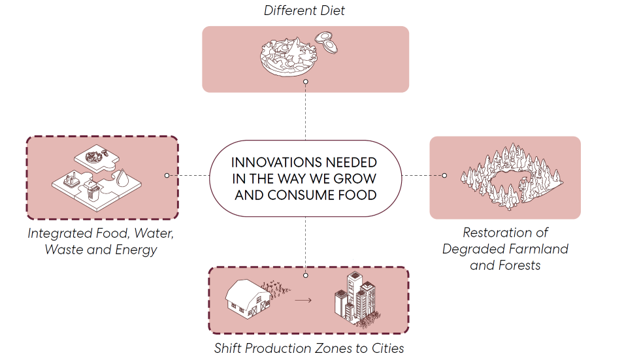
Innovation pathways for food security. Adapted from: Porter, et al., 2014.
Adapted from Porter et al. (2014), this framework is the report's way of situating BIA within a much bigger picture, it does not claim BIA alone solves the food security problem. The first two levers, shifting diets and restoring degraded farmland and forests, are largely global agricultural and policy reforms that sit outside architecture's reach. The built environment has its most direct and immediate role in the latter two: shifting production zones into cities and designing circular urban metabolisms that integrate food with water, waste, and energy systems rather than treating them separately. That's the argument for why Perkins&Will has a stake in this conversation, not because buildings can replace farms, but because they can absorb a meaningful share of production while closing loops agriculture alone cannot.
From the Report:
Part I, "The Balancing Act: Feeding a Growing Population Sustainably."