By 2050, 70% of the world's population will live in cities.
The demographic shift that turns building-integrated agriculture from a clever idea into a structural necessity.
70%
of the world’s population will live in cities by 2050
+56%
projected rise in global food demand
~50%
of the world’s vegetated land is already farmed
Mechanism
As urbanization concentrates the majority of humanity into dense settlements, it places unprecedented pressure on food, water, and energy systems originally designed for a less urbanized world. Today's urban consumption remains highly linear: cities consume vast resources with minimal mechanisms for recovery or reuse.
Consequence
Compounding this demographic shift is a second critical projection: global food demand is expected to rise by 56%. Meanwhile, agricultural land use has already reached a tipping point, with nearly 50% of the world's vegetated land—an area roughly twice the size of India—currently dedicated to farming.
Nuance
Expanding agricultural footprints to meet this rising demand would only accelerate deforestation, biodiversity loss, and climate instability. Therefore, the report asserts that this impending production shortfall cannot be solved simply by bringing more land under cultivation.
Design Implication
Because buildings form the dominant infrastructure precisely where population growth is concentrating, they present a logical site to absorb a share of global food production. This spatial shift is the foundational argument for Building-Integrated Agriculture (BIA) woven throughout the report.
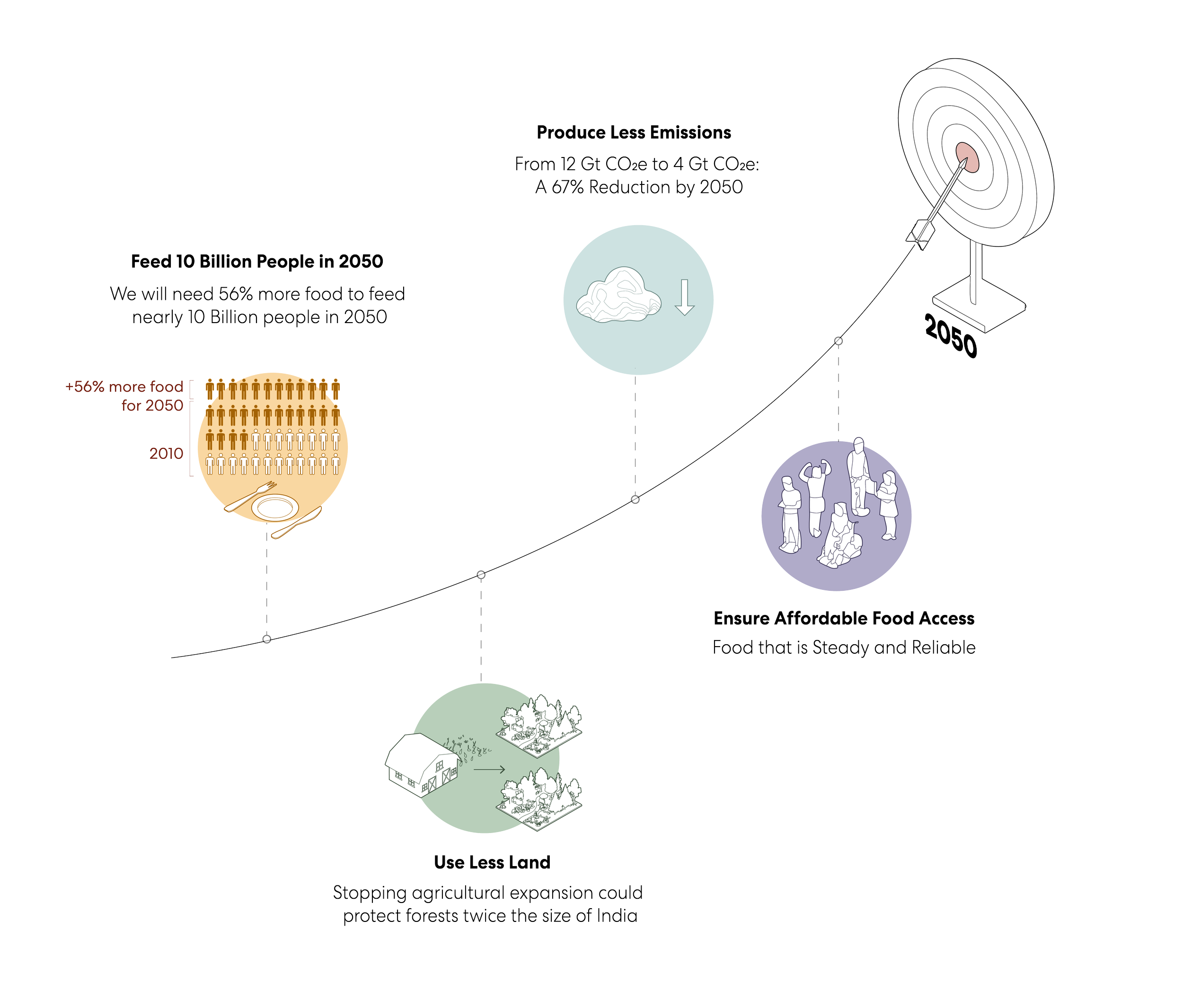
The global food challenge by 2050. Adapted from: World Resources Institute, 2018.