One-third of global GHG emissions come from food systems
How grabbing a meal became one of the biggest contributors to climate change
1/3
of global GHG emissions come from food systems
70%
of agricultural emissions stem from land-use conversion, deforestation, and soil degradation
30%
originate from post-production activities, including refrigeration, long-distance transportation, etc.
Mechanism
Food production is a leading driver of climate change, generating nearly one-third of global anthropogenic greenhouse gas emissions. Agriculture alone contributes roughly 12 gigatons of CO₂ equivalent annually, a figure that must shrink to 4 gigatons by 2050 to meet global climate targets.
Consequence
Currently, 70% of agricultural emissions stem from land-use conversion, deforestation, and soil degradation. The remaining 30% originate from post-production activities, including refrigeration, long-distance transportation, industrial processing, and waste-heavy distribution.
Nuance
The specific composition of these food-system emissions adds further complexity: 52% is CO₂, 35% is methane, 11% is nitrous oxide, and 2% is fluorinated gases. Because each gas requires a distinct mitigation pathway, reducing "food emissions" is not a single, monolithic lever.
Design Implication
A credible climate strategy must directly address food systems. The report positions Building-Integrated Agriculture (BIA) as one of the few interventions capable of simultaneously reducing both land-use and transport-driven emissions by relocating agricultural production directly into existing urban building stock.
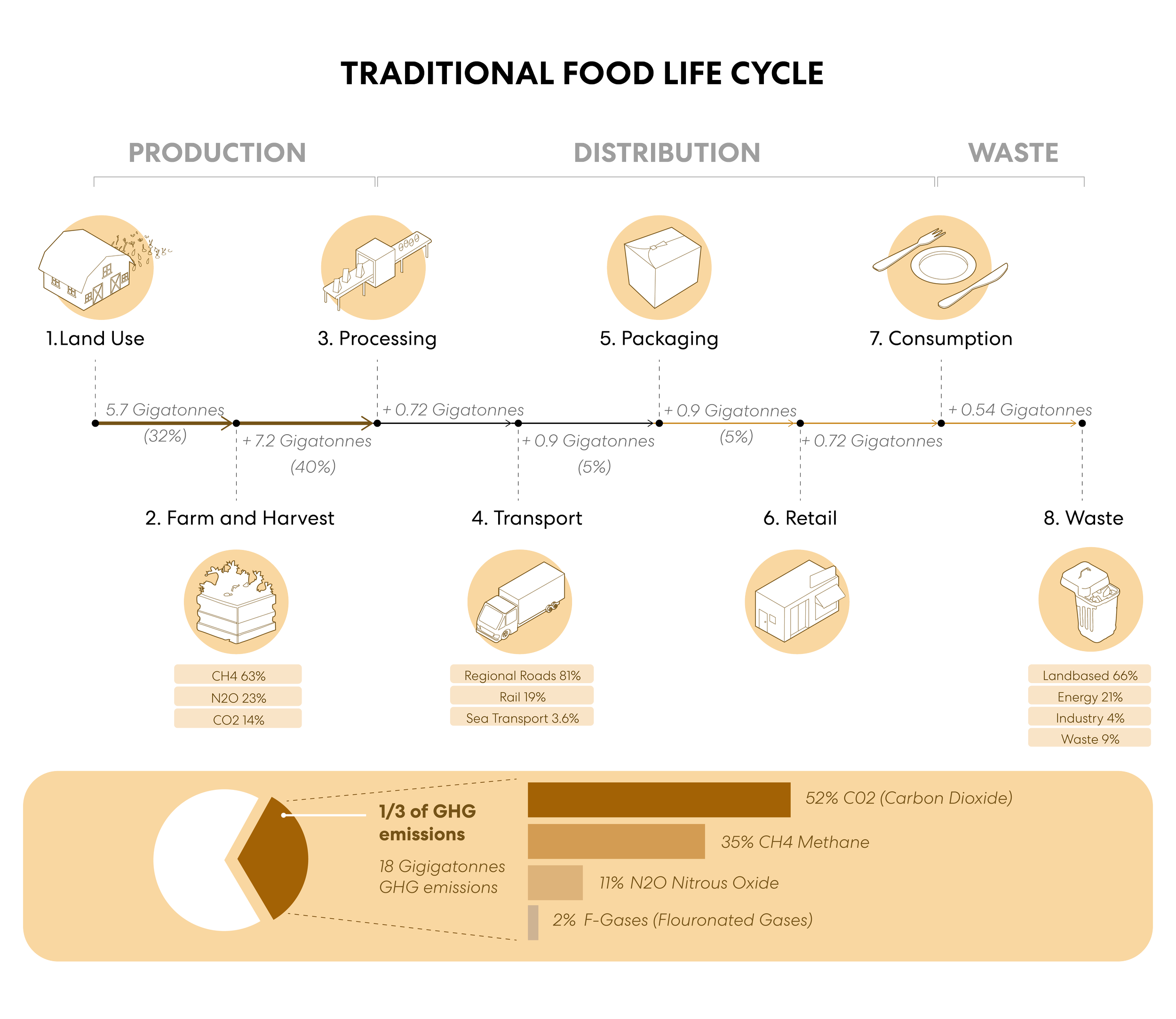
GHG emissions across the food production stream (EDGAR-FOOD, 2021).
Food systems contribution to global anthropogenic GHG emissions (EDGAR-FOOD, 2021).