42% of food produced is wasted along the supply chain
From seed to salad, the culprit lies in the process.
42%
of food produced is wasted along the supply chain
17%
lost to production
9%
lost to processing
6%
lost to handling and storage
7%
lost to distribution and retail
Mechanism
Losses occur unevenly across the supply chain before food ever reaches the consumer: production (17%), handling and storage (6%), processing (9%), and distribution and retail (7%). The specific concentration of these losses depends heavily on regional dynamics.
Consequence
According to the report, over 92% of farmed vegetable varieties have disappeared in the last century. This severe loss of biodiversity is directly tied to the monoculture-driven industrial agricultural systems that were designed, in part, to minimize supply-chain waste at scale.
Nuance
Cities consume 80% of global food production while generating 1.3 billion tonnes of organic waste annually, a volume that contributes 8–10% of global greenhouse gas (GHG) emissions. Food waste is not merely a production-side inefficiency; it is a massive, standalone emissions source.
Design Implication
Shortening the distance between farm and plate inherently reduces the number of handoffs where loss and waste occur. Building-Integrated Agriculture (BIA) achieves this structurally by producing food directly within the buildings where it is consumed, effectively bypassing the most vulnerable segments of the traditional supply chain.
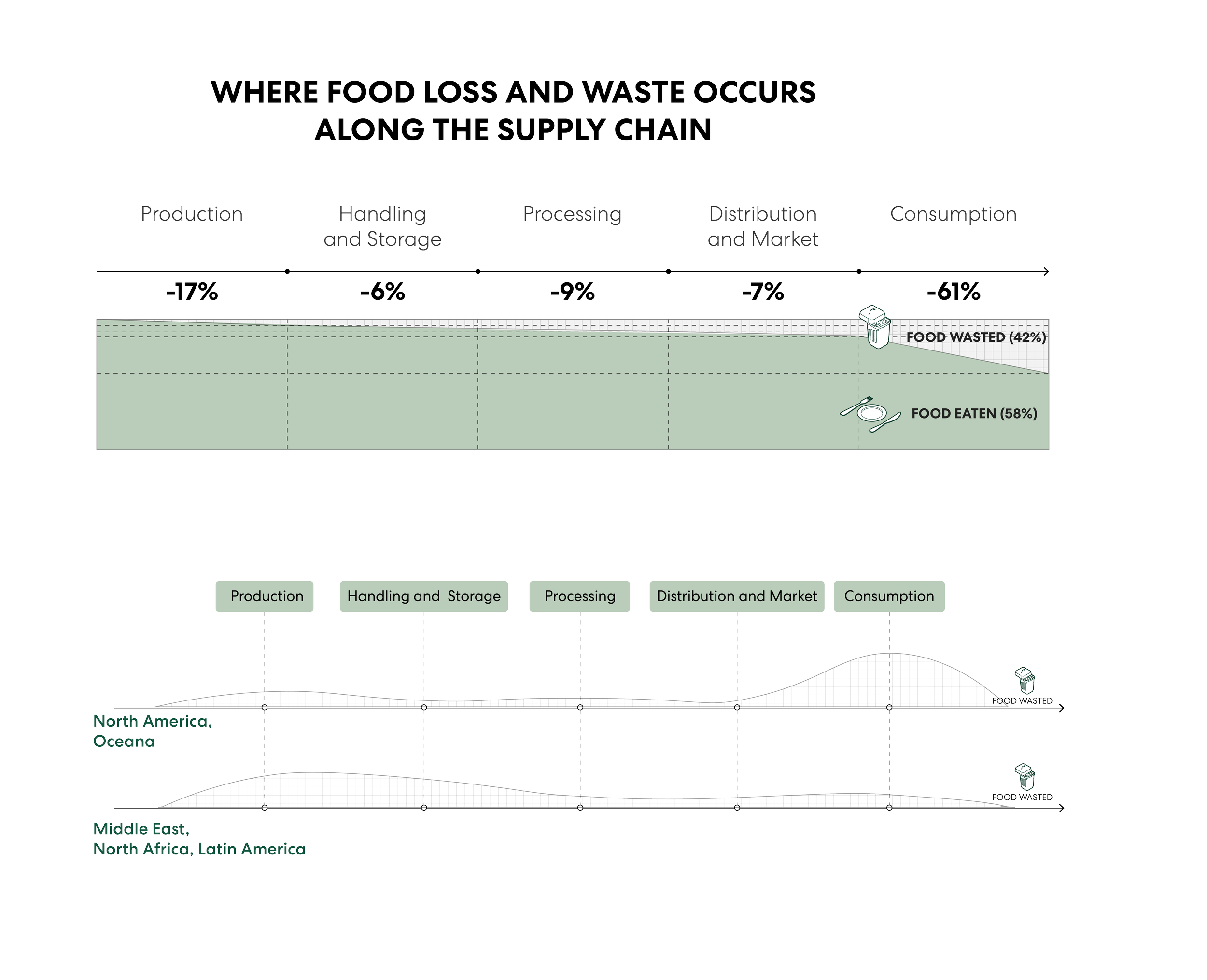
Food waste comparison across North America, MENA, and Latin America. Adapted from: World Resource Institute, 2018.