The Carbon Cycle in BIA Systems
How carbon actually moves through a building-integrated farm, sequestered by plants during growth, released through respiration and organic waste, and potentially recaptured directly from a building's HVAC exhaust.
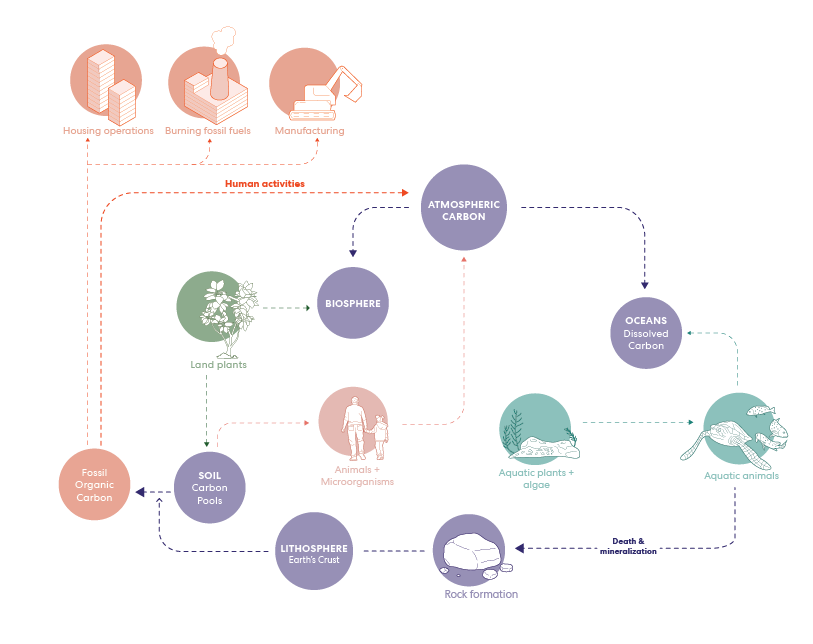
The carbon cycle. Adapted from: Proksch, 2017.
Adapted from Proksch (2017), this diagram is the mechanism behind one of the report's more counterintuitive claims: piping a building's HVAC CO₂ exhaust directly into a controlled-environment farm doesn't just dispose of an emission stream more responsibly, it measurably enhances plant growth, since elevated CO₂ concentrations improve photosynthesis in enclosed growing environments. The diagram traces exactly where in the building-farm system that carbon can be intercepted before it's lost to the atmosphere, and where it re-enters as biomass, food, or organic waste that can itself be composted or digested. It's the technical foundation underneath the "capturing CO₂ emissions from HVAC" strategy the report names early on as a key building-waste-to-farm-input move.
From the Report:
Part IV, "Carbon Reduction and Ecosystem Impact."